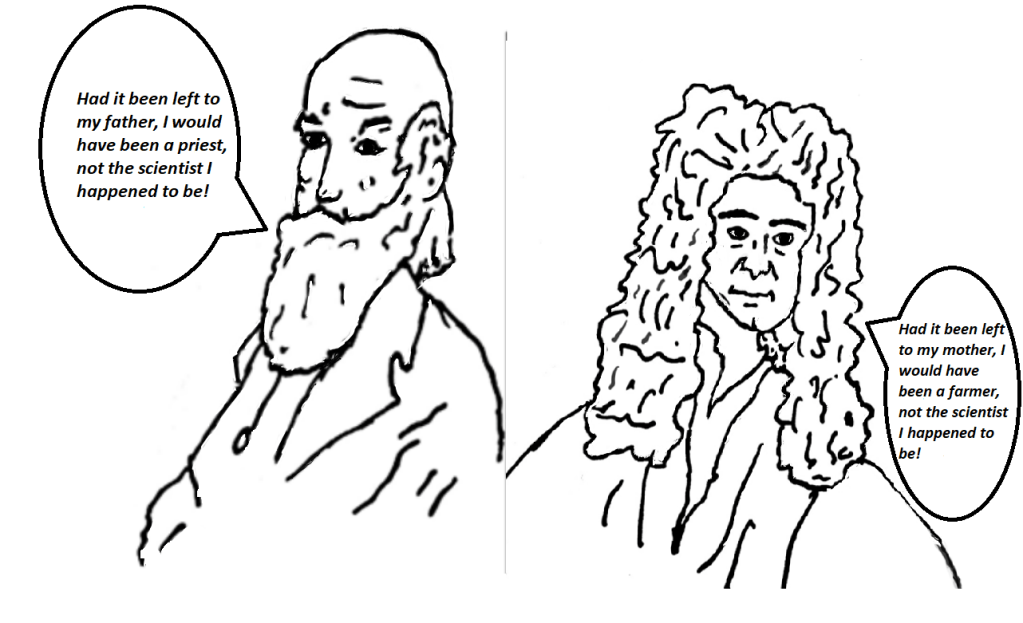
Isaac Newton was the father of classical physics. Charles Darwin was the father of evolutionary biology. Most of you would know who those men were. What you may not know is that, had it been left to their parents, they would not have been scientists at all. Let’s talk about Newton first.
Coming from a farming background, Newton’s mother wanted him to abandon school and take care of the farm. It was a practical choice considering those times. However, young Isaac wasn’t too keen about being a farmer. At the farm, he deliberately did a bad job; instead of tending the cattle, he would spend his days reading books and inventing ingenious mechanical devices.
Once when he was asked to look after the cattle, young Newton let them run into the neighbour’s farm and ruin the crops. His mother was hurled into the court and had to pay a fine to cover the damages. He wasn’t turning into the farmer his mother wanted him to be. Eventually, with the involvement of Newton’s uncle, his mother finally agreed to send him back to school. Today we know Isaac Newton as the greatest scientist that ever walked the planet.
While Newton revolted against a forced career choice, Charles Darwin proved to be a bit more submissive to his father. Robert Darwin, a doctor himself, wanted his son to study medicine. So young Charles Darwin was sent to Edinburgh University Medical School—the finest medical college in Britain—where his elder brother Erasmus was already enrolled. Contrary to his father’s ambitions, Charles found the lectures intolerably dull; the dissection of animals was a horrific sight for him, and he often escaped the place in disgust.
Meanwhile, Charles had developed a taste for natural history rather than medicine. As soon as his father learned about his lack of interest in medicine, young Darwin was presented a second career choice: to be a clergyman which, after a little bit of thought, he accepted. Nonetheless, before undertaking a vocation as solemn as priesthood, he was enrolled in the Cambridge University for studying arts. Although, at Cambridge, instead of studying arts, Darwin spent his time collecting beetles.
Subsequently, when Charles was nominated by a friend to join HMS Beagle as a naturalist, his father refused to allow him the opportunity. He thought the trip would just be a waste of time for his son. As had happened with Newton, one of Charles’s uncles came to his rescue and the elder Darwin at last agreed to fund the trip for the youngster. The rest, as they say, is history.
Fast forward to the twenty first century, most of us enjoy our individual liberties these days. Those of us who have had the freedom to choose our professional careers may not realize the battles Newton and Darwin had to wage against their own parents. However, for some readers, it might still be a relevant topic; some of us might still need to convince our parents about our professional choices. The following tips are intended to cover this subject.
One: Don’t Underestimate Your Profession
Most people work for money. However, what we do for a living impacts our personal lives as well. Here we are talking about nearly half of your waking hours. A few bad hours at work can ruin your entire day. And if your job becomes a daily drudgery, your entire life will feel like a waste. For example, if you hate your job, you might end up being an irritable person, or might develop unhealthy habits such as alcoholism, drugs, overeating, impulse purchasing, mobile phone addiction etc.
While the primary function of a job or a career is to meet your financial needs, professional satisfaction plays an important role in shaping your personality and identity. It gives you a sense of purpose and provides a direction to your life. So appreciate the value of your professional career; choose it wisely and deliberately. Don’t force yourself or let others force specific career choices onto you.
Your career impacts your personal life as well. Choose your profession deliberately and wisely.

Two: Understand Your Parents’ Perspective
Almost all parents want the best for their kids. And in general, your parents would have more life experiences than you. So before starting any discussion, try to understand and evaluate your parents’ perspective. Why are they insisting on certain careers, or why are they stopping you from certain careers? Are you being short-sighted? Could this be an emotional bubble on your part? Is that something you may regret later?
Before starting any discussion, put yourself in your parents’ shoes, and try to understand and evaluate their viewpoint. Are there any risks that your parents want you to avoid? What would you think if you were a parent? Try to analyze their thought process? Not only would this help you to get more clarity about your own choices, but it will also prepare you for a more meaningful conversation.
Put on your parents’ shoes, and try to look at your career choices from their point of view.

Three: Do Your Homework
Now that you have understood and evaluated your parents’ viewpoints, and assuming you are still convinced about your own preferences, start preparing for a dialogue. Gather information and examples in favour of your arguments. Look for a few success stories in the relevant fields. Anticipate and prepare for questions and counterarguments. Does your career plan need any financial investments? Do you have any backup plans if your chosen career doesn’t work for you? Think about various aspects of your career.
Once you are ready with some background information, rehearse with a sincere friend, if needed. Practice being calm and composed as you put your points across. Earmark a time and spot so that the discussion remains private. The better you are prepared, the more likely are you to convince your parents.
Preparation makes a real difference; do your homework rather than starting a random discussion.

Four: Remain Assertive Without Being Aggressive
Once you find the perfect conditions to strike up a conversation, start with some general topic and gradually get to the point. Regardless of the response — which could be cold and discouraging—do not lose your composure; remain calm and assertive. Be cautious of raising your voice as it will weaken your argument. Even if your parents disagree, treat them respectfully. Avoid being sarcastic. Do not throw hints about generation gap etc.
After some time, if you find that the discussion is not moving as you had expected, leave it open for future. If you see any ray of hope towards the end, allow your parents some time to rethink. It is an important matter and may not be concluded in a single sitting. Be patient and let it take its time.
Remain calm, composed, and assertive while presenting your arguments. Be a good listener; speak on your turn.
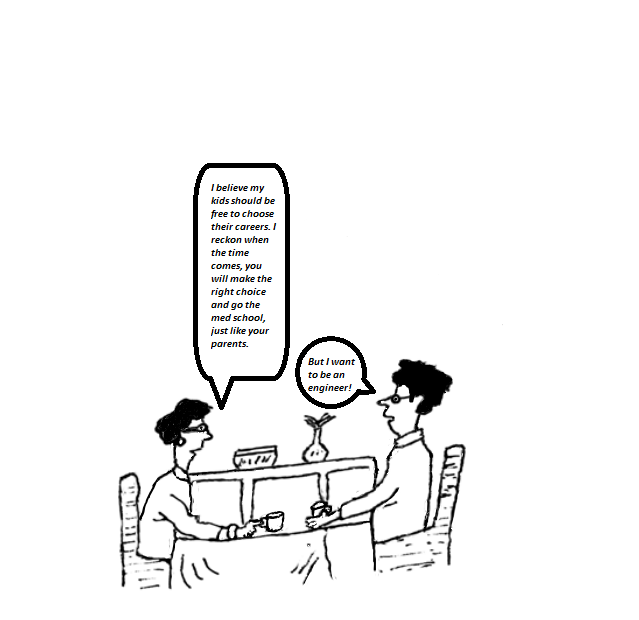
Five: Don’t Take Their Disapproval to Heart
Even if you fail miserably in convincing your near and dear ones, even if they reject your opinions vehemently, don’t take this to your heart. Don’t react immediately. Take your time to prepare a response for the next time. Yes, there is always a next time. But this time, get back to your parents more wisely and more convincingly.
Before making another attempt, conduct an analysis of what went wrong the first time. Was there anything for which you were not prepared? Did you lack in your planning? Did your arguments lack consistency? Did you lose your temper? Did you choose the wrong time? Did you choose the wrong spot? Try to answer these questions and prepare better for the next opportunity. Rather than hating yourself or your parents for the disagreement, look for positive improvements in your planning.
Don’t lose your hopes. Analyze your mistakes and make a better plan for the next time.
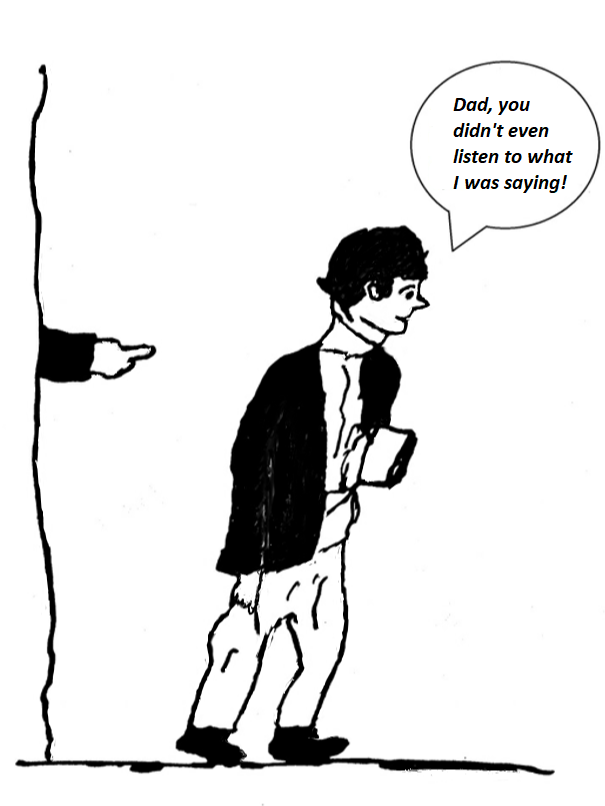
Six: Keep a Plan B Ready
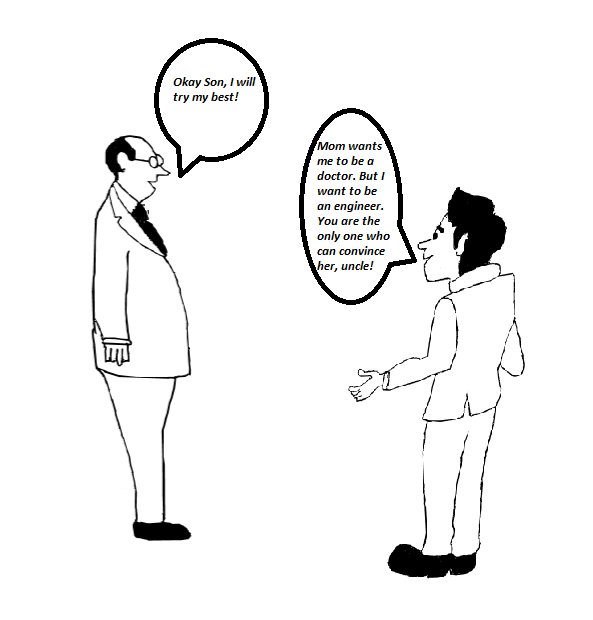
What if you try again and fail yet again. Well, you can try as many times as you want, but if nothing seems to work, you can think about alternative options. Learning from Newton’s and Darwin’s life stories, think about any relatives or family friends who can influence your parents; take those aides in confidence— This could be your plan B.
In fact, using an influential relative or family friend as a support could be your plan A. Instead of talking to your parents directly, your aunt or uncle could present your case as your advocates. Work out which should be a better option in your situation. But if your backers succeed in convincing your parents about your career choices, make sure you try your best to succeed in your career— don’t let your benefactors down.
Seek help from a trustworthy relative or family friend who can influence your parents to change their mind.
Seven: Make Your Own Decision
Above tips are intended to help you convince your parents about your career choices. But like so many things in life, there is no guarantee if any of your plans would work or not. In case all your efforts fail, you have one of the two choices: be like Charles Darwin who submitted himself to the career his father chose for him or follow the footsteps of Isaac Newton who forced his mother to concede her decision. The final choice is still yours. Good luck!
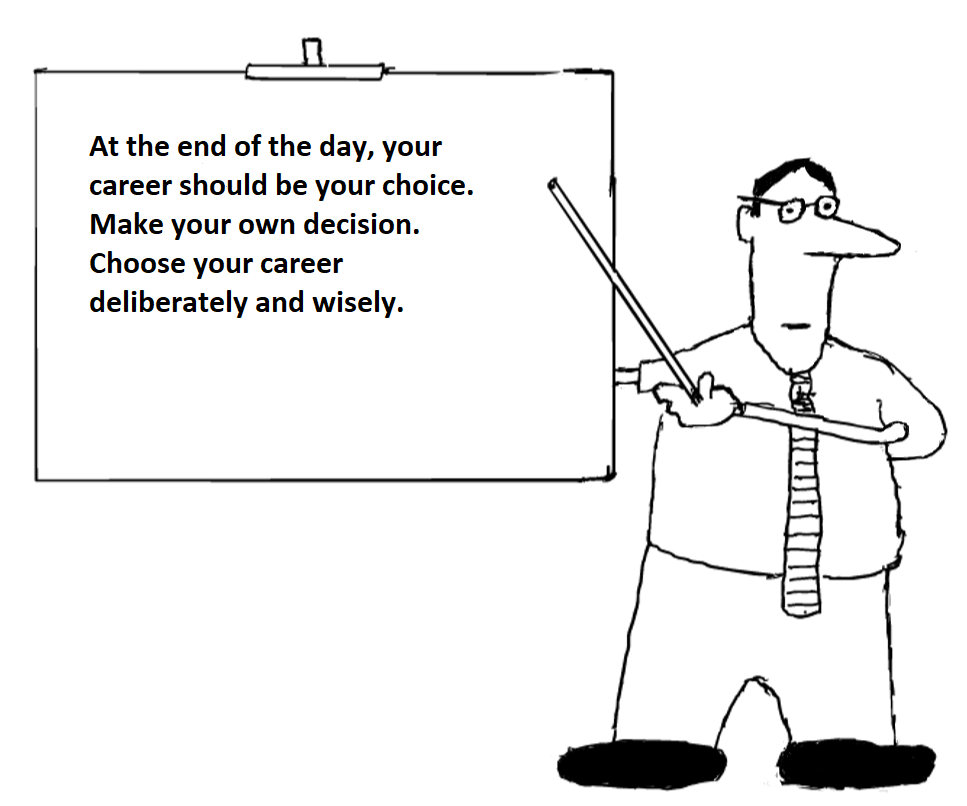
Your career, your choice.
Summary
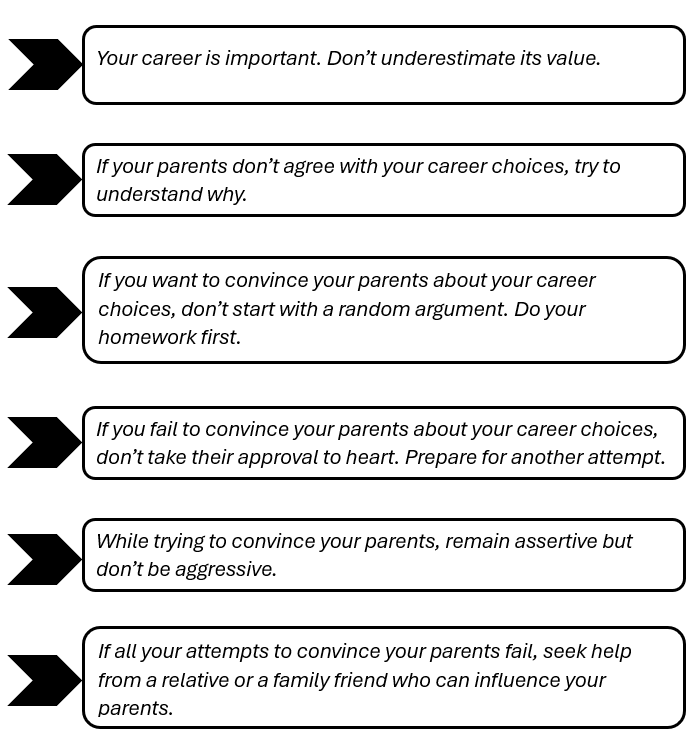
If your parents disagree with your career choices and you want to convince them, below tips can be useful:
- Your career is important; think well before accepting or rejecting your parents’ career advice.
- Try to understand your parents’ perspective before trying to convince them.
- Do your homework before starting a discussion.
- Remain assertive but don’t be aggressive to your parents.
- Don’t take your parents’ disapproval to heart. Get ready for a second attempt.
- Seek help from an influential relative or a family friend if needed.
 Amin Academy
Dear Amin,
What a beautiful name, prayers are granted 🙏 ❤️
I found your post quite interesting.
My post today is edited, reedited & republished one. There is not much novelty.
Despite that, thank you for liking, ‘Humility’. 💕💗😍🌹
LikeLiked by 3 people
Thanks for reading and liking.
LikeLiked by 2 people
Dear Amin
I found your post quite interesting.
My post today is edited, reedited & republished one. There is not much novelty.
Despite that, thank you for liking, ‘Unfollow’. 💕💗😍🌹
LikeLiked by 2 people
Thanks for reading and liking.
LikeLiked by 2 people
Dear Amin
I admire you even more for this post.
Thanks for liking my post, Security 🌹❤️🌹❤️
LikeLiked by 1 person
Thanks for reading and liking
LikeLiked by 2 people
Amin Bravo 👏🏻👏🏻👏🏻👏🏻
LikeLiked by 2 people
Thanks for reading and liking
LikeLiked by 3 people
Pleasure was all mine 😊
LikeLiked by 2 people
I tried to teach my niece to dream whatever she wants to be. Let her find her calling with the guidance from above. Parents sometimes dream for us, but it’s still us who choose what serves us and make us happy. Beautiful post, Amin.
LikeLiked by 4 people
Thanks Hazel, glad you liked the post. Parents wish the best for their kids, but off course, as you said, kids should have the liberty to follow their dreams. Appreciate your comment.
LikeLiked by 2 people
In the smoking room of a rain-lashed Scottish club, Isaac Newton jabbed his cane toward the cricket grounds.
“Cricket is plainly the superior sport,” Newton declared. “The heavier ball seeks naturally toward the Earth with God’s own urgency. A gentleman who can loft it longest demonstrates mastery over gravity itself.”
Across from him, Charles Darwin adjusted his waistcoat with visible irritation. “Nonsense. Fox hunting is the pinnacle of sport because weaker horses are naturally eliminated through selective exhaustion. Over generations, gentlemen become biologically refined. Cricket merely breeds accountants with bruised shins.”
Newton scoffed. “Your theory ignores the invisible ether, which clearly cushions horse-thoughts.”
Darwin snapped back, “And your gravity neglects the humoral imbalance caused by excessive wicket-keeping.”
The club went silent.
Finally the steward sighed and called for Donald Trump.
Three hours later he burst through the doors, pointed at both men, and declared:
“Terrific arguments. Truly confused. But golf is the most evolved sport because the ball already wants to live in the hole. Everybody knows this.”
LikeLiked by 1 person
Interesting scene, matching the title image of the article. Didn’t expect Donald Trump’s entry though😀
LikeLiked by 2 people
Newton ve Darwin’in hikâyeleri, ebeveyn baskısına rağmen kendi yolunu seçmenin önemini gösteriyor. Yazı, mesleğin sadece para kazanmak değil, kişiliği ve yaşamı şekillendiren bir unsur olduğunu hatırlatıyor. Kendi kararını vermek, bazen en büyük cesaret sınavıdır.
LikeLiked by 2 people
Thanks for reading and liking. I don’t understand Turkish so went to Google Translate; sharing the translation for anyone to understand your valuable comment: ”
The stories of Newton and Darwin illustrate the importance of choosing one’s own path despite parental pressure. The text reminds us that a profession is not just about earning money, but also about shaping one’s personality and life. Making your own decisions is sometimes the greatest test of courage.”
LikeLiked by 1 person
Great article. Thanks. I had a college student once who I suggested she should choose a different major, one that she actually liked and was good at. She exclaimed that she wished very much that she could, but both her parents were accountants and therefore she had no other choice also to be an accountant. That little conversation still haunts me.
LikeLiked by 1 person
Hmm, I thought we have come a long way from Newton’s and Darwin’s times when kids didn’t enjoy the liberty to choose their careers. But looks like it is still a contemporary topic. Selecting a career is a serious commitment; it should be chosen deliberately and wisely. Thanks for reading and liking. Glad you found it valuable. Cheers
LikeLiked by 2 people