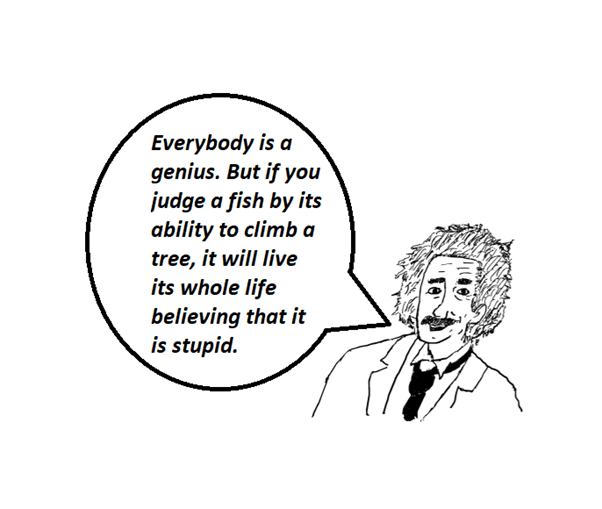
It is a commonly perpetuated fallacy that Albert Einstein was a dropout—a failure at school. Yes, he didn’t do well in history, geography, and French. And off course, he detested the regimental practices of his high school in Germany. But he was exceptionally brilliant in his favorite subjects: physics and mathematics. The punch line: Albert Einstein went on to become the greatest physicist of all times.
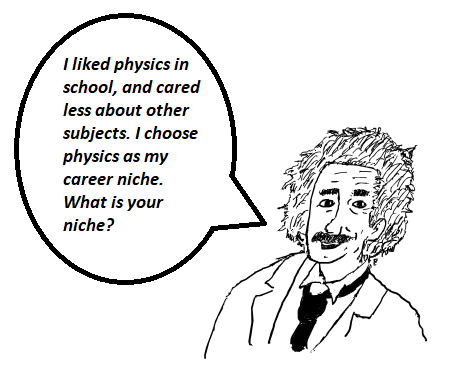
So did Einstein fail at school? Yes, in the subjects he didn’t like. Was he an academic failure? Not really. He just identified his passion early on and cared less about other subjects. He just chose physics as his niche at an early age, focused to pursue it, and made it into an enduring lifelong scientific career.
Whether you want to be a CEO, or a technical expert, your career path should be clear to you during the first few years of your professional career. This will enable you to channel your time and energy efficiently towards your chosen career objectives. Following the footsteps of Albert Einstein, you can also identify your passion and transform it into a career niche for yourself. But first let us understand what a niche means and why is it important to pick a career niche:
A niche is a specific skill you are good at. Mostly, it is derived from your natural abilities or talents. All living beings have some peculiar skills or niches: plants can turn sunlight into food, photosynthesis is their niche; lions can chase down and devour gazelles, so hunting is their niche. What is your niche?
Unlike plants and animals who possess a very narrow set of skills, we humans have the luxury of being able to choose a niche from a wide variety of options. We can even polish our talents. While we can select and refine our niche, it is advisable to take this step at an early stage of your career; this will enable you to dedicate your limited personal resources— time, energy, ambition etc.— towards your chosen career objectives.
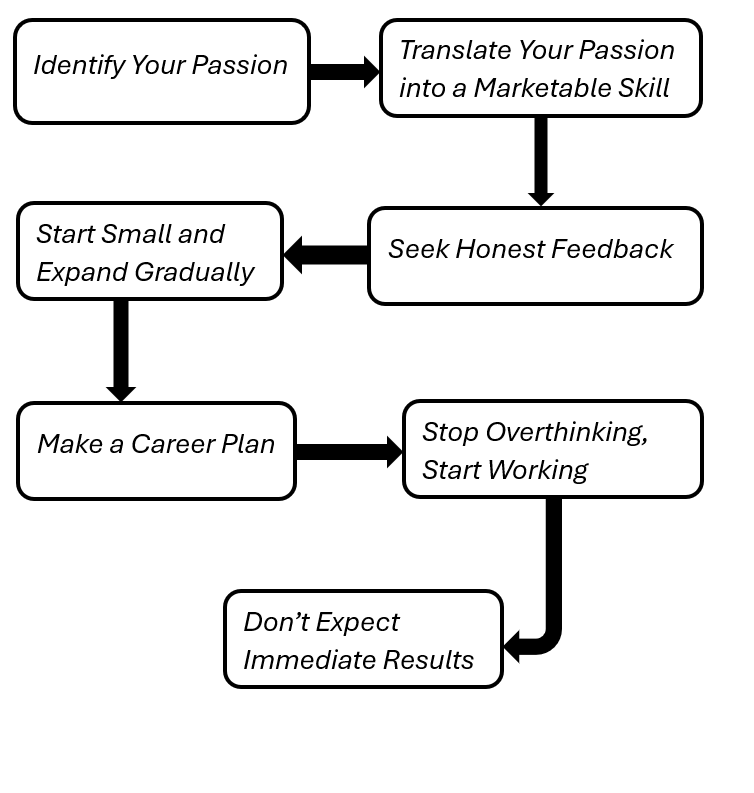
The following steps are intended to outline what you can do to land on to your career niche, thereby transforming your passion into your profession.
One: Identify Your Passion
What is your passion? To start with, what is meant by a passion? Simply defined, passion is an intense desire for something. Do all of us have a passion inside us? Well, this is debatable. Some people are content with what life offers and don’t try to find anything deep inside them. Then there are those who ignore their passions due to personal circumstances or professional obligations. Only a small number of people would pursue their passion no matter what it takes.
In order to identify your passion, ask yourself the following questions: Is there some activity that makes you forget your lunch? Is there some thought that inadvertently creeps into your mind as you wake up in the morning? If yes, that activity, that thought, may very well be your passion.
You may have numerous passions, and it often gets hard to narrow down to a few, but it is extremely important to reduce the list to as few as possible.
An ideal scenario would be to convert your passion into your profession. Identify your passion and convert it into your career niche.
How to limit the list of your passions to a minimum? Let’s see in the next step.
Two: Translate Your Passion into a Marketable Skill
Once you have identified and listed down your passion(s), the next step is to evaluate if one or more of them can be useful to anyone. Can you use your passion to solve anyone’s problems? How many people face those problems? Do you have large number of potential customers? Can you provide a unique, simple solution to a ubiquitous challenge? If the answer to these questions is yes, you probably can translate your passion into a marketable skill.
For instance, if your passion is ticket collection, it is much likely that only a few people would be enthused about this. On the other hand, if you are passionate about computers, you may develop a software to solve a problem for numerous people i.e. you can satisfy customer needs and market your skills. Limit your list by selecting one or two passions that could be transformed into marketable skills.
Determine if one or more of your passions have enough market demand.

Three: Seek Honest Feedback
You might be interested in a particular field and that field might have reasonable market demand, but ask yourself if you are good at it? Do some self-reflection. Ask some trusted fellows for candid feedback. Also, are you willing to invest time, energy, and possibly money to hon your skills in that field?
If the answer to above questions is no, drop this idea and pick something else. Repeat the process until you get to a single niche you are passionate about and either you are good at it or are ready to improve upon it. At this stage, it is important to ensure that you don’t end up with a long list of ideas — sometimes, less is more.
Choose a field that you are good at, and/or you are ready to invest your resources to improve your skills in that field.

Four: Start Small and Expand Gradually
Having found a marketable skill you are good at or willing to be good at, it is time to take some practical steps. However, instead of beginning with a grand start up, start with something small—small enough to be rolled up easily in case it doesn’t seem to work for you. This will reduce your risks — less risks, less nerves.
As an example, imagine you are passionate about food business and want to start a restaurant. Starting a regular restaurant would involve buying or renting a place, purchasing stoves, utensils, crockery etc. You probably would need to hire some staff as well. Add to that the administrative measures your local regulations may require. It is just not a simple thing for a beginner.
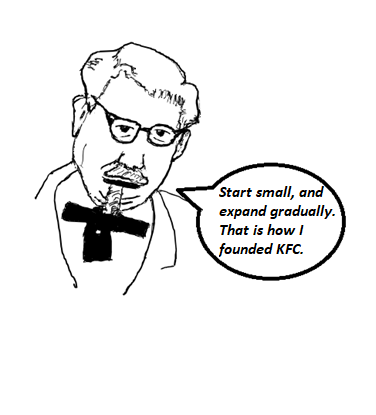
A wiser approach in this situation would be to start with your kitchen and start offering homecooked meals to your friends and family members. This will give you time to get some feedback and improve upon your skills and services. Once you gain confidence in your skills, you may decide to expand gradually. That is how Colonel Sanders founded KFC. However, before considering expansion on your business, it is useful to have a career plan. More on career planning in the next step.
Starting small will give you time to improve your skills. Once you are an expert, you can expand gradually.
Five: Make a Career Plan
Making a career plan involves outlining the steps you need to achieve your goals. What resources would you need in relation to those steps. Which items need to be actioned immediately? What to leave for later? Your career plan should also identify the relevant support and training requirements.
While developing your career plan, try to keep your goals realistic and attainable with regards to magnitude and timelines. Most of us overestimate our abilities and/or underestimate the quantum of work involved in achieving our goals. It is imperative to keep your career goals pragmatic and as clearly defined as possible. And don’t forget to review them periodically.
A career plan will help you expand in your chosen field, and keep your goals realistic and achievable.

Six: Stop Overthinking, Start Working
A lot of people get to the stage where they have a clear understanding of their passion and how they can transform that into a marketable skill, but then they stop there. They keep making plans and continue postponing them. They do not start the actual work until one day they realize that they no longer have the time and energy to pursue their dream career. Do not let this happen to you. Do not procrastinate on your plans.
Once you are clear about your career plan, start working on it. While it is important to start your career with a clear mind, overthinking should be avoided. And to be honest, no matter how detailed your plan is, you will always need to refine it as you learn along the way. So stop overthinking and start working on your goals.
Do not wait for a perfect plan. Once you have outlined your goals, start working and keep refining your plan as you learn more.

Seven: Be Patient
Our media often portrays successful people as smart people. However, a vast majority of successful people are both smart and hardworking, and they are perseverant. If you have surpassed the first six stages described above and successfully reached this last step, kudos to you. Nonetheless, this is not the end.
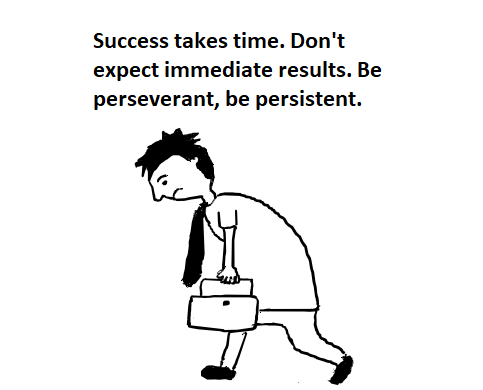
One of the prime reasons for failure in achieving your goals is lack of persistence. People fail to recognize that success takes time. It takes consistent efforts and several failures to achieve your goals. You might be brilliant at something, but you would still need perseverance and persistence to reach the summit. And if you are not ready to persevere, don’t even bother to choose a niche; you are good the way you are.
Success takes time. Do not expect immediate results. Be perseverant, be patient.
In A Nutshell
If you want to transform your passion into a profession, follow below seven steps approach:
- Identify your passion.
- Translate your passion into a marketable skill.
- Seek honest feedback about your abilities.
- Start at small scale and expand gradually.
- Make a career plan to expand your enterprise.
- Do not overthink; start working and update your plans as you learn more.
- Be patient; do not expect immediate results.
 Amin Academy
Pingback: How to Convince Your Parents About Your Career Choices | Amin Academy
Welcome 👋 good luck 💯
Grettings regards from 🇪🇦🌎
LikeLiked by 6 people
Thanks
LikeLiked by 4 people
Pingback: Basic Management for Beginners | Amin Academy
Valuable lessons! Thanks for reminding us to believe in ourselves!
LikeLiked by 2 people
Thanks for reading and liking. Glad you found it useful. Cheers
LikeLiked by 3 people
interesting… thanks for sharing
LikeLiked by 3 people
Thanks for reading and liking. Glad you enjoyed it. Cheers
LikeLiked by 3 people
Pingback: How to Overcome Procrastination | Amin Academy
Wish I would have known this stuff when I was younger. Hope your blog has lots of success and helps young people visualize a future that many of them see as non-existent.
LikeLiked by 1 person
Thanks for your wishes. Glad you found it useful.
LikeLiked by 2 people
Many young people need this encouragement.
LikeLiked by 1 person
Absolutely. Thanks for reading and liking.
LikeLiked by 1 person
Great lessons! Thank you for this reminder to keep building, learning, and trusting the process. Definitely going to keep coming to your blog for insight.
LikeLiked by 1 person
Thanks for reading and liking.
LikeLiked by 1 person
I shall be recommending this post to my younger relatives still searching for their niche! Thank you!
LikeLiked by 1 person
Thanks for the recommendation. Glad you found it useful. Cheers
LikeLike
The only things within reach of 7 easy steps are my TV and my fridge. Those aren’t going to really solve anything. I may need a few more steps.
LikeLiked by 1 person
❤️❤️❤️❤️
LikeLiked by 1 person
Thanks
LikeLike
Pingback: Seven Steps to Transform Your Passion into Your Profession – piccolicar
Thanks for sharing
LikeLike
AMAZING work of GREAT ADVICE, (y’all better take notes, this for retaining) and thank you for sharing. The NICHE, absolutely, carried mine for a very long time before I opened this UNIQUE GIFT and we all have at least one. Mine is the ability to look at anything and generate a creative project….from UPSCALING, CREATION, RENOVATION and BUILDING (Socially & Intellectually), CUSTOMIZED ART and just making SOMETHING out of NOTHING. What someone may look at as trash, I can see VALUE ( Intangibly). I even have this gift with people, by speaking life into them when they don’t have the energy or hope. Patience is definitely important and a wise one once shared, ” Don’t expect to eat the fruit from the tree, the same day you planted the seeds!”. You must tend to your garden for it to grow and the gems you dropped in this post, will make many abandon their procrastinating and START….BOTTOM LINE!!! 💯💯💯💪🏾💪🏾💪🏾💫💫💫
LikeLiked by 1 person
Thanks for sharing your feedback. You have an interesting niche— seeing value where others can’t see it, and creating hope for the dejected. Glad you found my article useful. Cheers
LikeLiked by 1 person
You are welcome!!!💫💫💫
LikeLiked by 1 person
Great synopsis.
LikeLiked by 1 person
Thanks
LikeLiked by 1 person